
Comment avez-vous débuté dans le monde du design vintage ?
Assez simplement, en réalité. Il fallait meubler mon tout premier appartement et c’est ainsi que j’ai commencé à aller aux marchés aux puces. D’abord la Place du Jeu de Balle à Bruxelles, quotidienne, chaotique, pleine de surprises, puis la porte de Vanves à Paris.
Mon œil s’est peu à peu formé à repérer les objets qui ont une présence, une histoire. Ce n’était pas encore une démarche tournée vers le design, mais plutôt un jeu d’intuition et de curiosité.
Votre formation était-elle liée au design ou à la culture ?
Pas sur le papier, non. À l’époque, j’étudiais les sciences sociales et la pédagogie, puis j’ai travaillé dans l’éducation nationale avant de me tourner vers le monde de l’art. Mes connaissances en design s’est faite sur le terrain au fil des ans à travers les collections, les observations et surtout les échanges passionnés avec des connaisseurs du geste et de la forme.
J’ai toujours été attiré par l’architecture. Par la manière dont les objets sont pensés, construits et par la relation qu’ils entretiennent avec l’espace. Avec le temps, ces intérêts sont devenus partie intégrante de ma vie professionnelle à travers l’art, la collection et récemment l’édition.
Je ne suis pas une philosophie de la « seconde main » ou du « vintage » et je trouve d’ailleurs que ce mot aplatit ou sursentimentalise ce qui devrait être considéré comme du « design historique ». Pour moi, l'accent est mis sur la signification culturelle et la qualité, pas sur la nostalgie.
Quel est votre domaine de spécialité ?
Ma collection a évolué à travers différentes étapes. J'ai d'abord été attiré par l’élégance et l’artisanat de l'Art déco français, mais les bouleversements du marché, les prix qui grimpent, m'ont poussé à changer de focus. Le modernisme français, puis suisse, m’ont ensuite captivé par leur rigueur et leur esthétique discrète.
Aujourd’hui, le « modernariato* » vous accapare. Ce mouvement des années 1950 à 1980 m’occupe aussi bien dans la recherche que dans l’édition. Inventivité, précision et poésie… Il y a là une richesse inépuisable.
Beaucoup de ces designers, souvent architectes de formation, ne créaient pas simplement des objets et des meubles : ils redessinaient l’espace domestique moderne.
D'où vient l'idée de ces ouvrages ?
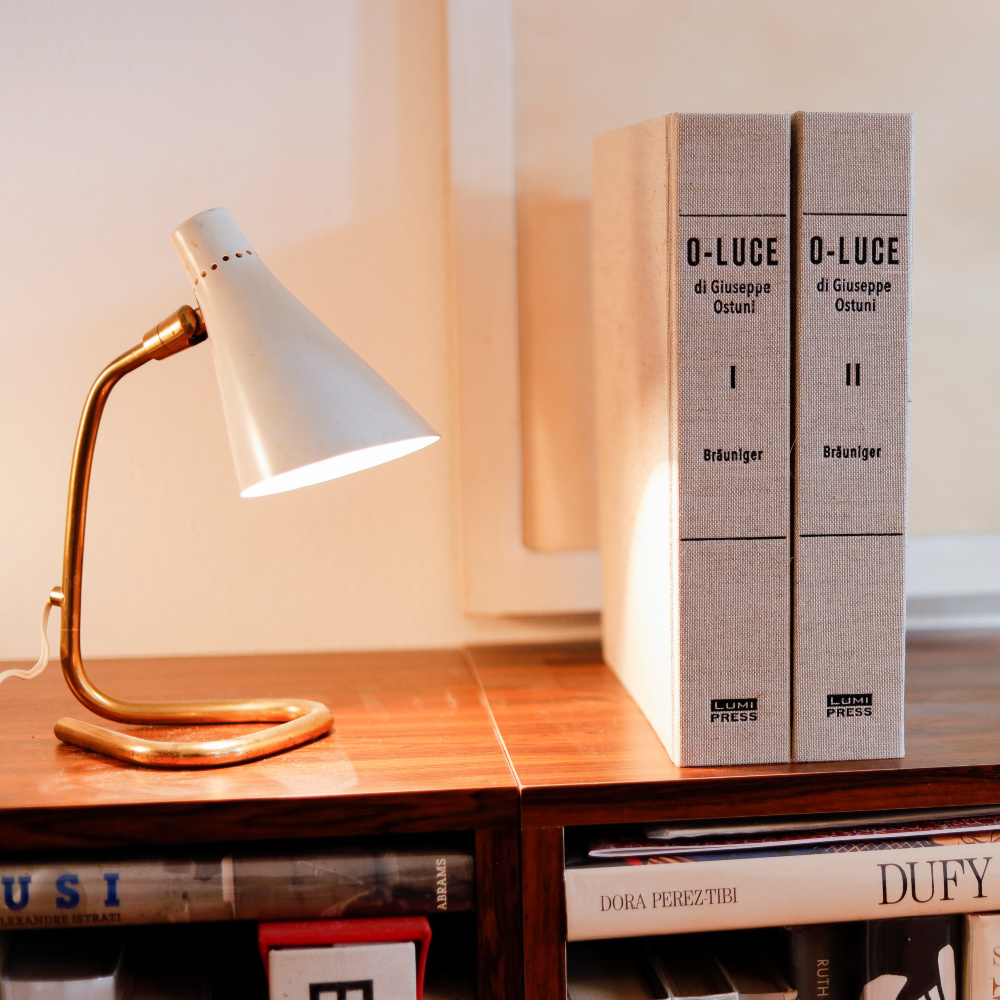
L’envie est née de ma collection personnelle. Pendant des années, j'ai réuni des pièces italiennes, notamment d'Arredoluce et surtout d'Oluce, la maison milanaise fondée par Giuseppe Ostuni en 1947. J'ai ressenti le besoin de fixer tout cela sur papier.
À ce moment-là, il n’existait quasiment rien de substantiel sur le sujet. La rencontre avec l’écrivain et le chercheur Thomas Bräuniger lors d'une exposition a été déterminante. Notre passion commune pour une période précise nous a naturellement conduits à collaborer. J’ai accompagné Thomas dans ses recherches et avec les nombreuses lampes de ma collection.
En 2021, naît LUMI PRESS…
J’ai fondé ma propre maison d’édition avec l’ambition de proposer des ouvrages indépendants, exigeants, esthétiquement soignés et fidèles à notre regard. Notre première publication a vu le jour dès le mois de mars de cette même année.
Comment ces livres sont-ils conçus ?
Notre approche est artisanale : nous concevons chacun de A à Z. Recherches, entretiens, documentation photographique, maquette, impression : tout passe entre nos mains.
À ce jour, nous avons publié deux ouvrages consacrés à Oluce, un à Stilnovo. Un troisième volume sur Oluce est en préparation pour novembre 2025.
L’accueil immédiat et enthousiaste de la communauté du design nous a surpris. Des collectionneurs, des marchands et même un éditeur de luminaires nous ont contactés : ils voulaient raconter leurs histoires, partager leurs archives. Ces échanges comptent parmi les plus belles récompenses du projet.
Qui achète les livres et quels retours recevez-vous ?
Notre public se compose de personnes profondément engagées dans le design. Il comprend des galeries, des maisons de vente aux enchères, des bibliothèques, des conservateurs, des collectionneurs. Ces lecteurs sont enthousiastes. Ils apprécient le sérieux de la recherche, l'esthétique des livres en tant qu'objets.
Notre travail les aide à identifier et à contextualiser les pièces d'éclairage. Certains nous ont même dit qu'ils avaient redécouvert des lampes qu'ils possédaient grâce à nos livres.
Quels sont vos projets ?
Nous finalisons le troisième volume sur Oluce. Après cela, nous allons nous consacrer aux créations d’un autre fabricant de luminaires italien. Une figure moins connue, mais importante dont nous avons récemment découvert les archives.
Notre objectif reste inchangé : préserver et donner forme à des chapitres négligés de l'histoire du design, avec profondeur, clarté et intégrité.
*Modernariato : ce mot italien définit les antiquités modernes, les pièces de design, fabriquées industriellement entre la Seconde Guerre mondiale et les années 1960-1980.
Contact :
Jean-Lou Majerus
LUMI PRESS
Cécile Ybert