
Une trajectoire singulière
En mai 1968, la revue Maison Française révèle une figure encore méconnue du design français : Maria Pergay, sculptrice, orfèvre et pionnière du mobilier en acier inoxydable.
Née en Russie en 1930 et naturalisée française, elle s’est formée entre arts classiques et pratiques manuelles, passant notamment par l’atelier du sculpteur Ossip Zadkine.
Antiquaire place des Vosges, elle nourrit une double sensibilité : le goût de l’ancien et l’intuition du contemporain. Cette tension deviendra sa signature. Pergay n’est pas une théoricienne du design, mais une praticienne : une chercheuse de formes qui fait du quotidien un terrain d’expérimentation.
L’acier inox, une révélation
À la fin des années 1950, Pergay abandonne l’orfèvrerie pour se consacrer à un matériau inattendu : l’acier inoxydable. Alors perçu comme industriel ou froid, réservé aux cuisines et aux laboratoires, elle y voit une matière noble et exigeante. « Je le sens aussi précieux que le plus précieux des bois », confie-t-elle.
Pour elle, l’acier n’est pas seulement résistant : il est pur, lumineux, fluide. Un miroir qui capte la lumière, une surface qui structure l’espace. Travaillé avec rigueur et douceur, il devient souple, presque poétique.
Des objets fonctionnels, pas des sculptures
La première exposition de Pergay à la Galerie Maison et Jardin, dirigée par Gilles Sermadiras, marque un tournant.
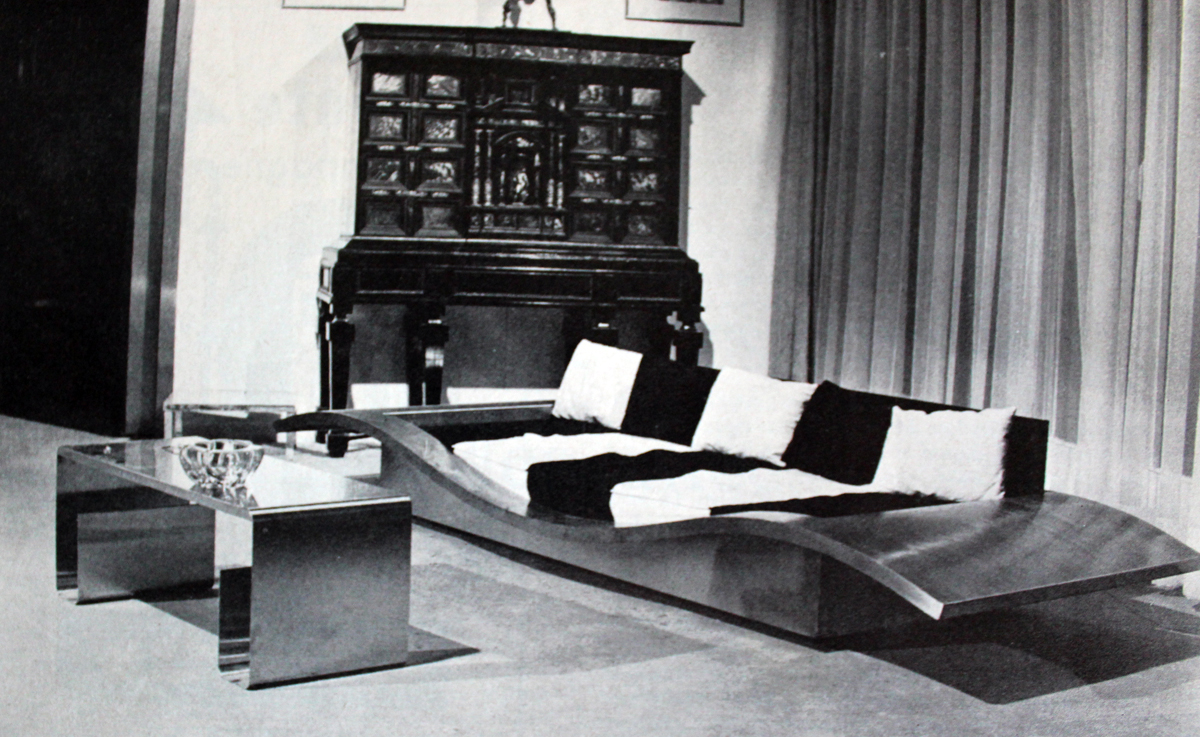
Ce ne sont pas des sculptures abstraites mais des objets fonctionnels : meubles, vases, lampes, cache-pots, cendriers. Pergay compose avec l’acier plié, cintré ou brossé, créant des assises sans âge, des tables en spirale, des fauteuils à bandes métalliques.
Son geste d’orfèvre s’applique au quotidien. « Très dur, l’acier exige une rigueur de ligne… et une main douce », explique-t-elle.
À une époque dominée par le bois, le formica ou le plastique pop, elle propose un langage inédit, radical et immédiatement reconnaissable.
Une vision d’avant-garde
Soutenue par la société Uginox pour l’approvisionnement et par Manelec pour la fabrication, Pergay imagine un mobilier qu’elle rêve de rendre accessible au plus grand nombre. « Il suffirait de quelques machines et de commandes pour industrialiser cette démarche », disait-elle déjà en 1968.
Son ambition n’était pas de faire du luxe, mais de trouver la justesse : un mobilier moderne capable de coexister avec l’ancien, d’entrer en résonance avec toutes les cultures. « Si un meuble moderne supporte de vivre à côté d’un meuble du XVIIe ou d’un objet d’art africain, c’est qu’il est juste. »
Une œuvre en dialogue permanent
Pergay a toujours parlé de son travail comme d’un dialogue avec la matière : « Je compte beaucoup sur l’acier lui-même pour me dicter le meilleur. »
Ce dialogue a duré toute sa vie. Redécouverte dans les années 2000 par des galeries internationales comme Demisch Danant ou Galerie Downtown François Laffanour, elle est aujourd’hui célébrée comme une pionnière.
Ses meubles des années 60 et 70 atteignent des sommets sur le marché, mais leur valeur dépasse l’économie : ils portent la trace d’une femme libre, qui a su faire parler un métal réputé froid avec une sensibilité rare.
Source : Extrait de Maison Francaise — Mai 1968
Pour Gilles Sermadiras qui dirige et anime la Galerie Maison et Jardin, l’acier inoxydable demeure un matériau d’avant-garde dont l’emploi en décoration ne fais que débuter. C’est pourquoi dans un esprit de renouvellement et de dynamisme il accueille aujourd’hui ces œuvres audacieuses.
Ce ne sont pas des abstractions mais des objets fonctionnels faits pour un usage courant : meubles, vases, lampes, cache-pot, cendriers. La Galerie Maison et Jardin, présentera début mai au public les œuvres de cette artiste, née en Russie, naturalisée française et qui, après des études classiques a travaillé dans divers ateliers dont celui de Zadkine. Les chemins qui conduisent à la naissance d’une œuvre très nouvelle sont parfois étranges mais peuvent se comprendre. Antiquaire place des Vosges, elle a le goût du meuble, du beau matériau, du beau travail de l’ébéniste. Créateur d’orfèvre depuis 10 ans, son goût au cours de ces années de contact avec les métaux se forme ; s’aguerrir, se purifie. Bientôt elle ne peut plus supporter de travailler autre chose que ce métal pur, invulnérable qu’est l’acier inox. Très dur, il exige une rigueur de ligne en même temps qu’il demande à être traité en matière noble. « Je le sens, dit-elle, aussi précieux que le plus précieux des bois »
Elle devine rapidement quelle utilisation rationnelle pourrait être faite de ses qualités exceptionnelles, mais elle est, au premier abord, impressionnée par la force, par la somptuosité qu’elle lui voit.
Pourtant elle s’y attaque avec courage, emportée par une passion. Si le prix de ce matériau sont relativement élevés par rapport à ceux qu’utilise le mobilier actuel (bois laqué, plastique), il suffirait « de quelques machines et de commandes » pour que ce type de mobilier exceptionnel, une fois industrialisé, puisse être ramené à des prix aussi abordables que les autres. C’est donc avec confiance qu’elle aborde l’avenir, encouragée et aidée par la Société Uginox et pas son responsable de la promotion artistique, M. Martel ; secondée et conseillée sur le plan technique par M. Dancoine, directeur de la Société Manelec qui l’édite.
Marie Pergay a parmi les créateurs de formes contemporaines cette originalité d’être aussi une spécialiste de la chose ancienne et c’est ce qui donne une valeur particulière à sa conviction profonde : « Si un meuble moderne supporte de vivre à côté d’un meuble du XVIIe ou avec des objets d’art africain ou mexicain, c’est qu’il est bon au juste »
La création de cette collection n’est qu’un début. D’autres objets, projets, décors, l’attendent et la passionnent. « Je compte beaucoup, dit-elle, sur l’acier lui-même pour me dicter le meilleur et j’espère que ce dialogue durera longtemps car je crois que je peux faire beaucoup mieux que ce que j’ai déjà fait. Comme dans toute recherche d’expression il faut une maturité. Or, je commence seulement ».
Achille