
Your book French Design 1950 is subtitled “The Young Wolves Generation”. Could you remind us where this expression, used to describe the designers of that decade, comes from?
Solange Gorce, editor-in-chief of Maison française, coined the expression in the 1950s. A specialist in modernity, she was particularly receptive to the work of these designers who, at the time, really were both “young” and “wolves”. She was also a friend of Michel Mortier. She promoted their work, invited them to write… They enjoyed considerable success in the press.
Later, Patrick Favardin also highlighted the historical and aesthetic importance of these designers. As a gallery owner and art historian, he had the academic authority to remind people of their significance and to point out that the period could not be reduced solely to the work of Jean Prouvé, Charlotte Perriand, Serge Mouille or Jean Royère… When referring to these designers, he adopted the term “young wolves”. For my book, which in turn focuses on this generation, I eventually adopted the now-established expression.
Who were these designers? Were they from the same generation, and did they follow similar educational paths?
The generational concept does not correspond perfectly to the decade: the core of my research covers the period between 1951 and 1961. Nevertheless, I think the term is quite accurate. It reflects a broader phenomenon.
These designers were indeed almost all born between 1925 and 1930, with only a few exceptions. The same applies to their education. The École des Arts Décoratifs, Arts Appliqués, Camondo… They all attended leading French schools in the years following the war, and all ranked among the very best students of their class! The expression “young wolf” describes these highly ambitious individuals very well: they had an extremely high regard for their profession. Finally, these designers followed similar career paths and received similar forms of recognition.
What did they have in common? Did they share the same approach?
Marcel Gascoin — probably one of the most significant names in the decorative arts of the second half of the 20th century — had an enormous influence on their careers.
A designer and interior architect renowned for his major contribution to modern furniture during the post-war reconstruction period, he trained them and convinced them to devote their talents to designing the best possible objects for the greatest number of people, rather than creating private mansions for billionaires.
The young wolves developed new technical and aesthetic solutions for the modern apartment. They designed elegant chairs, furniture and lighting suitable for mass production. They had a genuine sense of ethics when it came to the use of materials and the pursuit of the perfect design. Nothing in their creations was gratuitous. There were no decorative additions. Everything had a function.
To me, their motivation and their demanding standards were almost a mission. They even fought to stop being referred to as decorators, advocating instead for the term “interior architect” and for the right to be involved in a project from its earliest design stages.
What career paths did they follow?
They all went on to have remarkable careers, each with their own particular specialities. In the early 1950s, these young graduates began by approaching small emerging publishers and manufacturers. They then went on to work with larger companies, while some also received commissions for private apartments.
After the 1950s, they all began receiving major private and public commissions: these French designers became the leading interior architects of the Trente Glorieuses, France’s three decades of post-war economic growth. Museums, ministries, prefectures, airports… By then, post-reconstruction France had recovered to its pre-war level and was investing heavily in projects related to culture, diplomacy, industry and transport.
Alain Richard, for example, designed dozens of museums and bank branches in France and around the world.
Janine Abraham and Dirk Jan Rol specialised in retail design. They created magnificent, ultra-modern shops, including those of Huchers-Minvielle, with enormous glass shopfronts seamlessly integrated into 18th-century buildings in major regional cities. They also developed the three-dimensional visual identity for 400 Yves Rocher stores.
Joseph-André Motte designed around a hundred metro stations as well as airports, while André Monpoix worked on projects for the Ministry of Social Affairs and various prefectures.
What legacy did they leave in the history of design?
The birth of design coincided with the emergence of the young wolves generation. With only one or two exceptions, they were the first designers who, after leaving school, were not the people manufacturing the objects but rather those conceiving and signing them. They created standard models intended for production.
They benefited from the energy of the early 1950s. There was demand: people had new apartments and there was a taste for modernity. The post-war generation needed furniture. At least in theory, because in practice France remained very traditional: tubular metal legs and mass-produced furniture sold relatively poorly during the first half of the 1950s, and even up until 1957–1958.
After 1962, the young wolves moved on to other things, but they also left their mark by training future generations of designers and architects.
Did they have close relationships with one another?
They cannot really be described as a formal group, but — with a few exceptions — they all knew one another.
Some were extremely close friends, shared apartments and went on holiday together. Others, such as Alain Richard and Jacqueline Iribe, or Janine Abraham and Dirk-Jan Rol, became couples.
Professionally, Pierre Guariche, Joseph-André Motte and Michel Mortier met while working in Marcel Gascoin’s studio. They soon joined forces to establish the ARP (Atelier de Recherches Plastiques).
Publisher Georges Charron, meanwhile, was behind the creation of Groupe 4 (René-Jean Caillette, Geneviève Dangles and Alain Richard, Joseph-André Motte), which produced furniture with highly modern lines.
If you had to choose just one piece from the decade, what would it be?
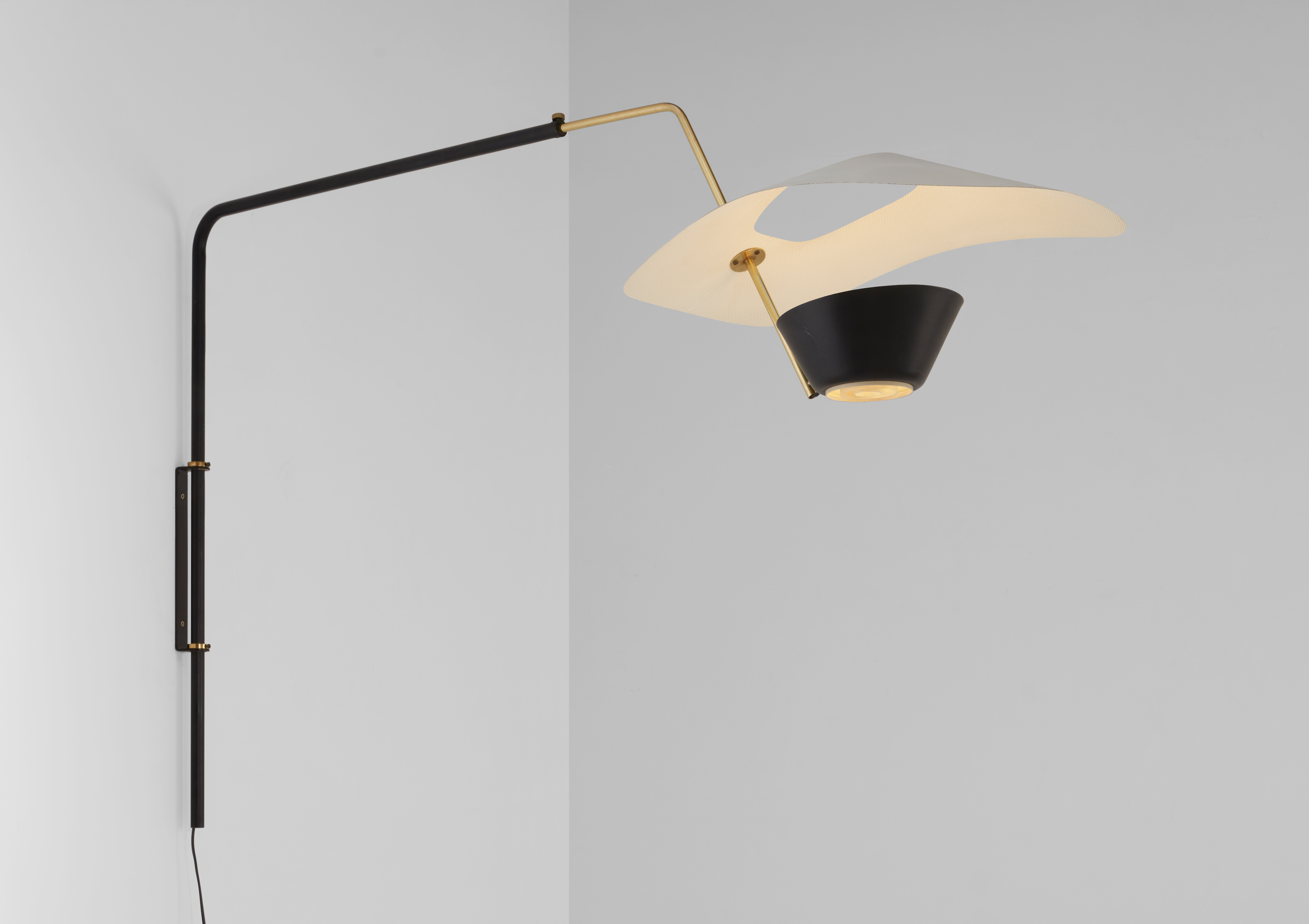
For me, it would be the G25 wall light, created in 1951 — an absolutely unique piece. It was one of the very first lighting designs by Pierre Guariche, who, together with Robert Mathieu, was one of the world’s greatest lighting designers. It perfectly illustrates what this entire generation was striving to achieve.
Aesthetically, it is a spectacular, sophisticated and elegant object. It resembles an orchid. The G25 also produces an extraordinary quality of light: I do not know of any other example where a single light source provides three different types of illumination. Pierre Guariche attended an engineering school before studying at the École des Arts Décoratifs. He relied on scientific research to design lighting fixtures capable of producing the ideal light for a specific location and purpose within the home: reading floor lamps, bedroom wall lights, desk lamps, ambient lighting… He developed this combination of direct, indirect and reflected light.
The designer himself never reused this exact principle. His later designs often combined two types of lighting, but using two separate bulbs.
What were the main challenges you faced during your research?
The greatest difficulty was having to reconstruct everything… and finding the money to do it. It took years of research and cross-referencing documentation to establish the facts and determine, for example, which lighting designs were genuinely by Guariche among the roughly 2,000 models that had been attributed to him!
I bought a great many period magazines in which these pieces had originally been published. I worked with young researchers, consulted library collections and family archives. I also interviewed people who had actually experienced that period: publishers including Meuble TV, as well as my friend Dirk Jan Rol, who taught me a great deal about the era, together with people close to the designers and their legal successors.
The millions of pieces of information and photographs gathered over twenty years of research now form an archive that allows me to provide completely reliable expertise on the pieces I present.
In addition, I had to build a collection in order to organise exhibitions, publish books and introduce all of this work to clients who were unfamiliar with it. I was the first to do so! Some rare models were produced in only three or five examples, so you may have to wait ten years before one appears on the market. And then, of course, you need to have the money to acquire it! Because if you miss the opportunity, you will probably never see another one.
How has the market evolved?
When I started, barely 10% of the work produced by this generation was properly documented.
Since then, the market has risen considerably, as everyone has noticed, but market values remain largely disconnected from the relevance, innovation or intrinsic quality of the pieces. Paradoxically, the best-known pieces — and therefore often those produced in the greatest numbers — have increased in value more significantly than the rarest ones.
French collectors are interested in these pieces, but I work primarily with specifiers, architects and interior designers, and unfortunately, many of the finest examples ultimately go to the United States.
Find out more:
Design français 1950. La génération des jeunes loups, by Pascal Cuisinier. Published by Éditions Pascal Cuisinier / Flammarion.
Cécile Ybert