
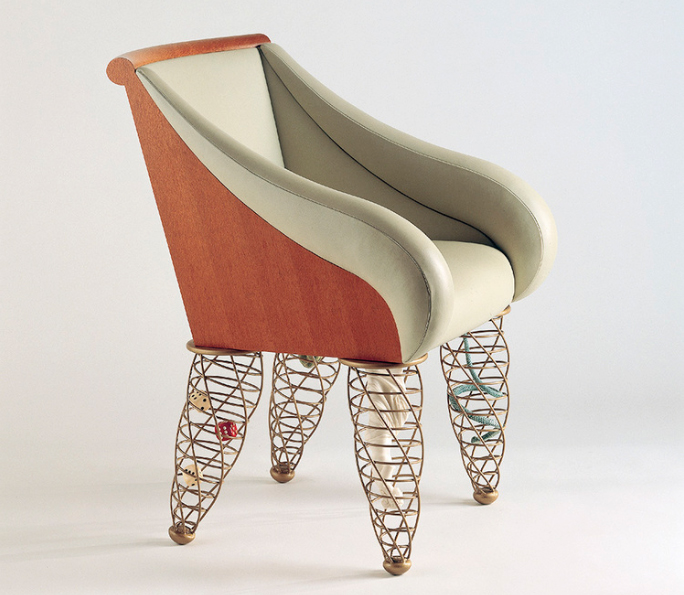
En 1991, Sylvain Dubuisson signe pour le bureau de Jack Lang un fauteuil à la fois sculptural et narratif. Suite ingénue n’est pas un simple siège ministériel : c’est un manifeste où l’histoire, la poésie et l’ingénierie dialoguent dans un esprit résolument français.
Un vocabulaire formel entre classicisme et fiction
Le fauteuil frappe d’abord par sa présence sculpturale. Les pieds en acier laqué ton bronze s’enroulent en torsades spiralées, évoquant autant les colonnes baroques que le décor de la période Restauration — un clin d’œil assumé à l’histoire du lieu.
À l’intérieur de ces volutes métalliques, le designer insère des motifs en résine : une Vénus de Milo miniature, un serpent, un artichaut, des dés. Autant d’indices énigmatiques qui relèvent moins de la citation que du récit. Dubuisson aime « cacher » des histoires dans ses objets. Ici, le fauteuil devient presque cabinet de curiosités.
Le berceau du siège, réalisé en bois de Louro Faïa, est garni de mousse et habillé de cuir. La rigueur technique dialogue avec une dimension poétique. L’ensemble dégage cette tension caractéristique de Dubuisson : érudition classique, précision industrielle et goût pour l’énigme.
1989 : le tournant
La commande ministérielle s’inscrit dans une trajectoire précise. En 1989, Dubuisson présente au VIA (Valorisation de l’Innovation dans l’Ameublement) son bureau 1989, édité par Fourniture. Cette pièce hélicoïdale marque un tournant décisif dans sa carrière.
À cette époque, le designer collabore également avec Jean Pauchard (Tolix) pour des pièces exigeantes :
- Le fauteuil Aéro en tôle perforée roulée,
- La chaise L’Aube et le temps qu’elle dure en aluminium,
- La table Portefeuille à plateau pliant.
Ces créations, ancrées dans un esprit moderniste, témoignent de son intérêt pour l’ingénierie et la mise en tension des matériaux.
Une singularité dans le paysage des années 1980-1990
Né en 1946 (et non 1953), formé à l’architecture, Sylvain Dubuisson s’installe indépendamment au début des années 1980. À rebours d’une génération qui revendique un design expressif inspiré de la culture pop ou de la bande dessinée, il développe un langage personnel nourri de littérature, de sciences et de technologies de pointe.
Son perfectionnisme est légendaire : il visite les usines, interroge la tolérance des matériaux, ajuste les proportions au millimètre. Cette exigence technique s’accompagne d’une dimension conceptuelle rare dans le design français de l’époque. Sa reconnaissance institutionnelle est rapide : Grand Prix National de la Création Industrielle (1990), "Créateur de l’année" au Salon du meuble de Paris (1990), et de multiples distinctions dans les années suivantes, notamment pour le mobilier hospitalier (APCI, 1993).
Un fauteuil ministériel… resté sans ministre
Conçu en 1990 à la demande de Jack Lang, alors ministre de la Culture, le fauteuil Suite ingénue" devait initialement accompagner des réunions informelles au Palais-Royal. Jack Lang évoque alors l’idée d’un « fauteuil volant » — une pièce à la fois symbolique et spectaculaire.
Mais l’histoire prend une tournure inattendue. Jugé trop expressif, presque « baroque » dans sa charge symbolique, le siège est finalement écarté. Conservé dans les réserves du Mobilier national, il n’est officiellement utilisé par aucun ministre.
Il faudra attendre deux décennies pour que la pièce ressurgisse et soit présentée au public à la Cité de l'Architecture et du Patrimoine, révélant toute la richesse narrative imaginée par Sylvain Dubuisson : Piètement en spirales d’acier laqué bronze, inclusions en résine renfermant Vénus de Milo, serpent, artichaut ou dés — autant de clins d’œil érudits qui transforment l’objet en cabinet de curiosités miniature.
Paradoxalement, cette mise à l’écart participe aujourd’hui à son aura.
Plus qu’un fauteuil ministériel, "Suite ingénue" est devenu un manifeste : celui d’un design français capable d’audace, d’ironie et de profondeur symbolique — quitte à déranger le pouvoir qu’il était censé servir.
Sources et références principales
– Mobilier National, 1964-2004 : 40 ans de création, Réunion des Musées Nationaux, Paris, 2004.
– Valérie Guillaume & Gérard Laizé, VIA design 3.0, 1979-2009 : 30 ans de création, Éditions du Centre Pompidou / VIA, 2009.
– Archives VIA (Valorisation de l’Innovation dans l’Ameublement).
– Fonds Mobilier National, documentation sur l’aménagement du cabinet du ministère de la Culture.
Achille