
La couleur comme manifeste
Dans l’histoire du design scandinave, Verner Panton occupe une place singulière. Né au Danemark en 1926 et formé à l’Académie royale des Beaux-Arts de Copenhague, il appartient à la génération qui succède à Arne Jacobsen, dont il fut un temps l’assistant.
Mais là où le modernisme nordique privilégiait souvent la retenue et la neutralité des matériaux, Panton choisit une voie plus audacieuse : celle de la couleur, de la courbe et de l’expérimentation.
Sa création la plus célèbre, la Panton Chair, conçue au début des années 1960 et éditée par Vitra à partir de 1967, incarne cette révolution. Première chaise réalisée d’un seul tenant en plastique moulé, elle rompt avec les structures traditionnelles du mobilier. Sa silhouette en porte-à-faux, à la fois fluide et sculpturale, transforme un objet du quotidien en véritable manifeste formel.
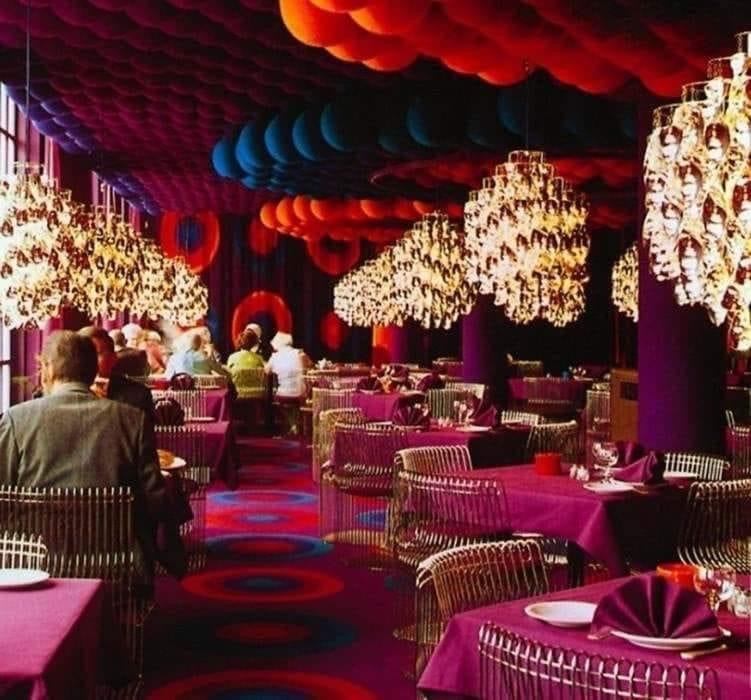
Mais Verner Panton ne se limite pas à l’objet. Dans les années 1960 et 1970, il imagine des intérieurs immersifs, où mobilier, textiles et luminaires composent un univers total.
Couleurs saturées, motifs géométriques, formes organiques : ses installations transforment l’espace domestique en expérience sensorielle. L’environnement devient presque psychédélique, reflet d’une époque qui explore de nouvelles libertés esthétiques et culturelles.
Aujourd’hui, les créations de Verner Panton continuent d’incarner l’esprit expérimental du design du XXᵉ siècle. Plus qu’un styliste, il fut un chercheur de formes et d’atmosphères. Ses meubles rappellent que le design peut être à la fois fonctionnel et radical, capable de transformer un intérieur en territoire d’imagination.
Pour les collectionneurs, ils demeurent l’un des témoignages les plus vibrants de l’optimisme créatif des années 1960.
Références bibliographiques :
Verner Panton . Éditions Taschen, Cologne, 2000 (rééd. 2016).
Verner Panton. The Collected Works . Alexander von Vegesack & Mateo Kries . Vitra Design Museum / Hatje Cantz, 2000.
Verner Panton Design AG
Archives officielles : https://www.verner-panton.com
Références historiques :
- 1967 : production de la Panton Chair par Vitra, première chaise en plastique moulé d’un seul tenant produite en série.
- 1969 : Visiona II, l’installation immersive créée pour Bayer à la foire du meuble de Cologne, l’un des projets les plus emblématiques du design expérimental.